

Although far from shore, a dozen or so community members whacked a beach ball around the room on a recent Wednesday at First Presbyterian Church in Wooster.
The group meets in the small city in northeast Ohio every week for a memory cafe, an opportunity for people with dementia and their caregivers to craft, eat together and exercise.
Most importantly, David Wilkin, 87, said it’s an opportunity to see his friends. Wilkin, who has Alzheimer’s, has been coming each week for the last couple of years with his wife and caregiver Betty.

“It's one of the few times in a week when I can see other people,” he said.
More than 236,000 Ohioans are living with Alzheimer’s, according to the Alzheimer’s Association. Memory care advocates say even more have undiagnosed or other forms of dementia. Many of them, like Wilkin, rely on a family member to care for them.
Memory cafes have popped up across the state as a space where both can find community.
Breaking social isolation
People with dementia, like Wilkin, often withdraw into themselves, out of embarrassment or fear. But, Wooster cafe founder Carole Klingler said the memory cafe breaks that isolation and offers a support network.
“They gain something,” Klingler said. “Where a lot of times people are walking away, I feel like we say, ‘Hello, come on in, we're here for you.’”

These cafes have grown increasingly popular since they were first introduced in the Netherlands in the 1990s.
There are at least a dozen in Ohio. Klingler runs seven across northeast Ohio through her organization LIFE: A Dementia Friendly Foundation. Others are held in Columbus-area libraries, at the Toledo art museum and even in conjunction with memory treatment centers.
Some doctors even “prescribe” memory cafes to their patients. Dr. Roopa Anmolsingh, Cleveland Clinic lead geriatrician for community programs, helps facilitate three cafes in Cleveland.
“It's being able to not just talk the talk, but give families the ability to also have access to resources that can promote patients' brain health,” Anmolsingh said.
Brain benefits
Social isolation is linked to a greater risk for dementia, according to a study published by Johns Hopkins researchers.
Sharing conversations and moving together can benefit the brain, Anmolsingh said. Preliminary findings from her cafe suggest cognitive test scores are more likely to hold steady among patients who attend the memory cafe compared to those who don’t.

She said caregivers are benefiting, too. Those surveyed reported a decrease in feeling burnt out.
“They're not playing the role of a caregiver when they're at the cafe, but they're actually enjoying time as a daughter or a son, having fun with mom or dad,” she said.
When caregivers aren’t feeling as overwhelmed, Anmolsingh said they’re less likely to need the medical system to step in.
“We're seeing less hospitalizations for our patients,” she said. “Because if you're burnt out and somebody who has late-stage dementia with behaviors, a burnt-out caregiver is going to have low tolerance to say, ‘All right, you know what, I'm taking them to the ER because this is too much to handle.’”
‘You’re there to be helped’
Liz Miller said the Wooster cafe is just as much for her as it is for her mother, Lynn, who has Alzheimer’s. It gives her a way to get out of the house without having to find respite care.

She said she often feels guilty or selfish when she needs a break. She doesn’t feel that at the cafe.
“No one's asking a lot of you … because they need help. You’re there to be helped,” Miller said.
Founder Klingler said sometimes the cafe brings in speakers or hosts sessions specifically geared toward peer support. But, for the most part, families are just there to create music or art with their loved ones.
It’s a time to focus on all the things that those with dementia are still able to do and create, said Salli Bollin, CEO of MemoryLane Care Services and Toledo memory cafe founder.
“A lot of times when people have health conditions like this,.. it takes over their personhood in a lot of ways,” she said. “But that's just one part of who they are.”
Reconnecting
Wooster cafe participant Wilkin said the opportunity to play music is his favorite part.
“I used to be quite a musician actually,” he said.
He used to play piano, trombone and organ. But on this August afternoon, he had a go at the handbells. The group worked together to ring out a song on color-coordinated bells, giggling any time a note was missed.
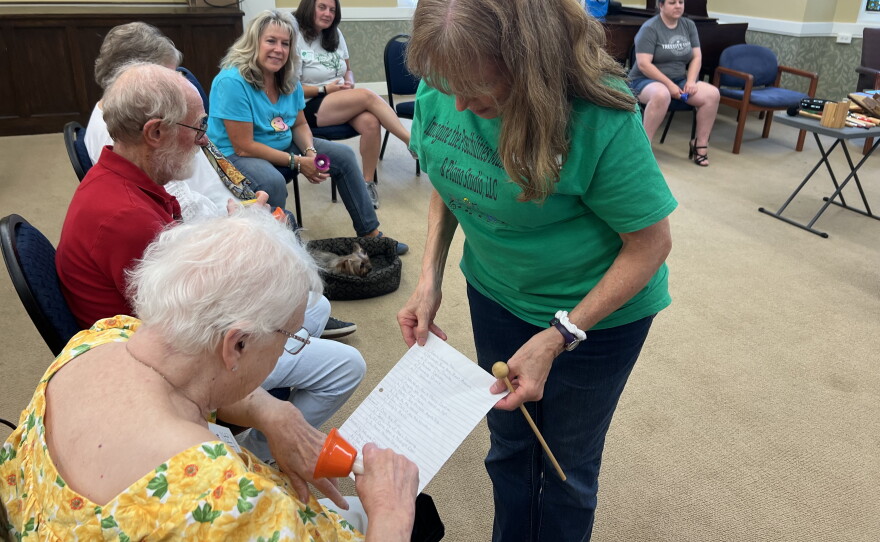
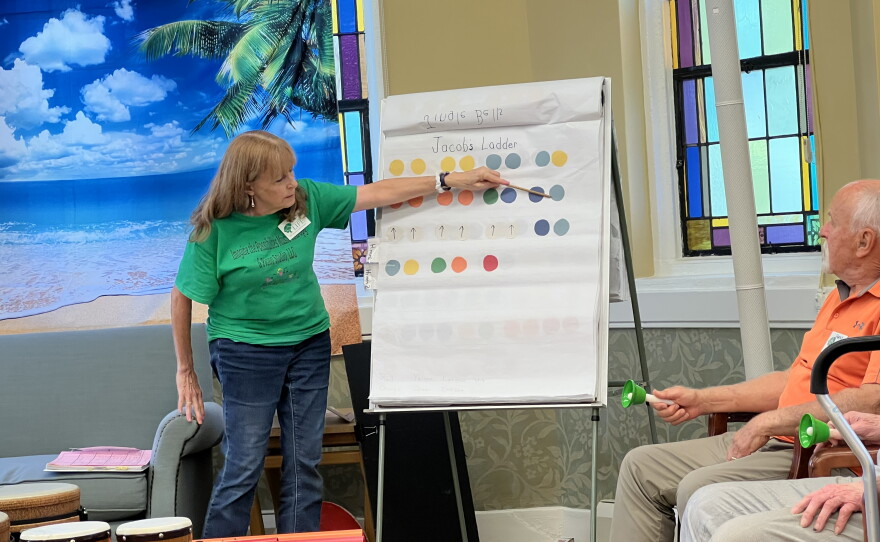
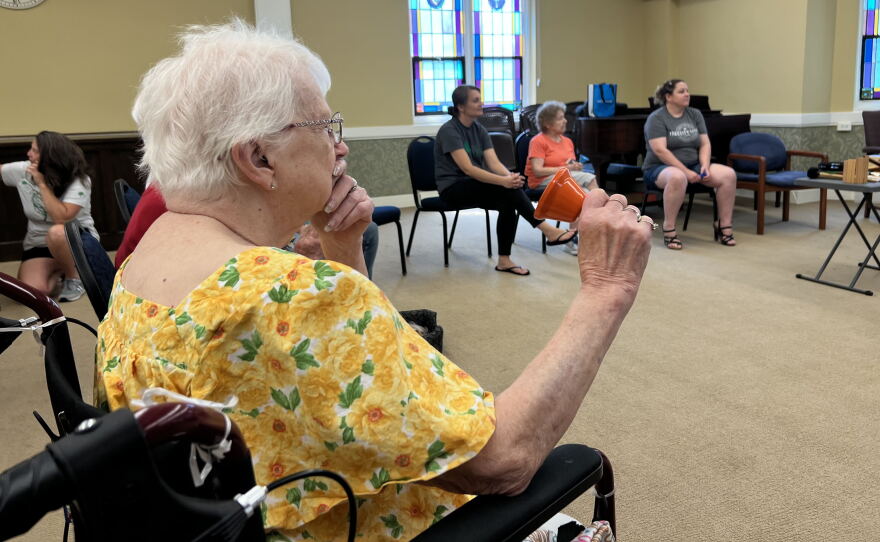
“Play it loud and proud!” another participant shouted.
Amid the chiming and the laughter, it’s impossible to tell who is a caregiver and who is being cared for. Klingler said that’s the point.

“Maybe they've had a rough ride over here, but on the way out they're happy and they have that camaraderie again,” she said.
When the afternoon’s programming ended, most milled out the door, making promises to check in with each other before next week. But Wilkin stayed behind. He sat down at the piano in the corner and played a tune.
He said it might be hard for him tomorrow to remember what he did today. But, in that moment, he couldn’t stop smiling.


